
A Consulting Shift to Buying Accountability
By Randy Armknecht
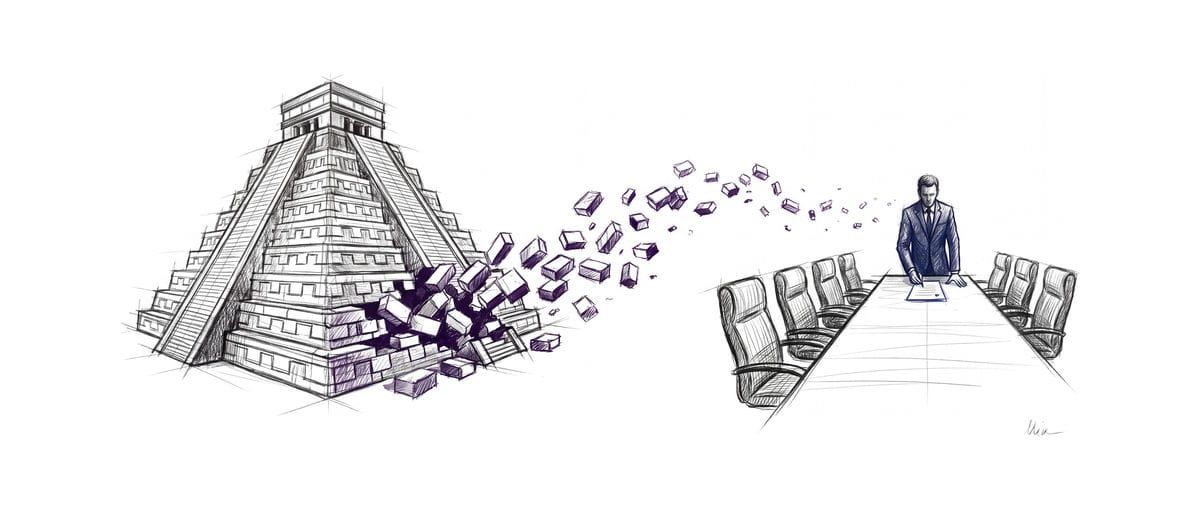
For most of my career, the consulting model was easy to explain. Clients paid for experience. At the top sat a partner who had seen the problem a dozen times. Under them sat a pyramid of analysts and consultants who did the research, built the models, and turned it all into decks. The partner's experience was the product. The pyramid was how it got delivered, and the hours were how it got billed.
That pyramid is changing shape, starting at the bottom.
The bottom of the pyramid got cheap
The work at the base was analysis: pull the data, benchmark the peers, summarize the interviews, build 40 slides that say what the partner already suspected. That work is now fast and cheap. A good analyst with AI tools can do in an afternoon what used to take a team a week. A client with the same tools can do much of it on their own.
The big firms see it, and their restructuring shows it.
In April, PwC UK announced it would merge its risk and consulting practices into a single advisory business of roughly 4,600 people, effective July 1. It was part of a global push to standardize PwC's consulting after UK consulting revenue fell. The hours of analysis that graduates used to bill are shrinking, and two separate practices that each staff their own junior pyramid stop making sense when there's less pyramid needed to staff. Industry watchers expect the impact to land first on graduate hiring. PwC says it will keep investing in entry-level staff, though the expectation from the market is a reduced volume of entry-level personnel. So far, its UK graduate intakes already run a couple of hundred below past levels.
Deloitte came at it from the other direction. Since June 1, its 181,500 US people no longer climb the analyst, consultant, senior consultant, manager ladder. Every title is now a job family, a specialty, and a level. A senior consultant is an L45 in something specific, like functional transformation, project management, or software engineering. Deloitte said pay and reporting lines stay the same. What went away is the assumption that everyone starts as a generalist doing analysis and decks and works their way up. Instead of changing the shape of their pyramid, they've broken the large generalist pyramid up into multiple smaller more specialized ones.
Entry-level work is moving from decks to engineering
Put those two moves side by side and the direction is clear.
PwC UK pulled about 900 technologists into a delivery unit for AI engineering, cloud, and data. Firms are competing to hire forward deployed engineers, people who sit with the client and build the thing instead of describing it. The junior person is less likely to be formatting the steering committee deck. They're more likely to be wiring an agent into the client's systems, or to be the specialist who knows one regulation or platform cold.
AI produces analysis quickly. Standing up a working system inside a messy enterprise, and bringing deep, narrow expertise into a room full of people who will push back, still takes a person.
The scarce thing is a name on the recommendation
With analysis cheap and the deck writing itself, plenty of things can produce a reasonable recommendation.
What's scarce is someone who will put their name on it.
I've seen more of this as we've helped organizations define their strategy. The client often has the data. They may have already run it through a model and gotten a sensible answer. What they want from us is someone who will first challenge then stand behind the decision, defend it in front of executive management, and take the hard questions from the board. Someone who says "this is what we recommend, and here is why," and is still in the room when it gets questioned.
That's accountability, and it's personal. A model can't be called into the boardroom. A model's reputation isn't on the line if the strategy fails. A consultant's is.
Buying outside help often now means matching the model to the need, with that accountability attached to each. A large program that needs structure, governance, and people on the ground for months still fits the classic pyramid, with a base that looks more like engineers and specialists than analysts. A strategy that has to be built or run calls for specialists and engineers who can deliver it. A decision headed to the board calls for a senior person who will sign the recommendation, present it, and own the outcome. Many engagements mix all three. The mistake is buying one out of habit when the problem calls for another.
For the people selling, the test is simple: which recommendations would they defend to a board, by name? That's where the value is growing, whatever model delivers it.
For the people buying, experience still matters, though it's no longer the whole offer. Look for someone willing to be accountable for the solution to the ask, in whatever shape fits the problem.
🤖 AIL LEVELS: This content's AI Influence Levels are AIL3 for the writing, and AIL4 for the images. AI Influence Level (AIL) framework