
Idea to Tablet in Eight Days

By Randy Armknecht
My daughter likes jigsaw puzzles on her tablet. The free apps deliver 2 things reliably: a puzzle, and an ad every few minutes. She asked for one without the interruptions, and she had opinions about what the pictures should be. On October 10 I opened Claude Code and described a grid jigsaw where pieces swap in place and snap together when they belong side by side. 8 days and 19 commits later, most of them sent from the Claude mobile app to a remote session on my Linux workstation, jigsaw.sleepingbear.tech has 50 levels. She plays puzzles "she made" without "always being interrupted."
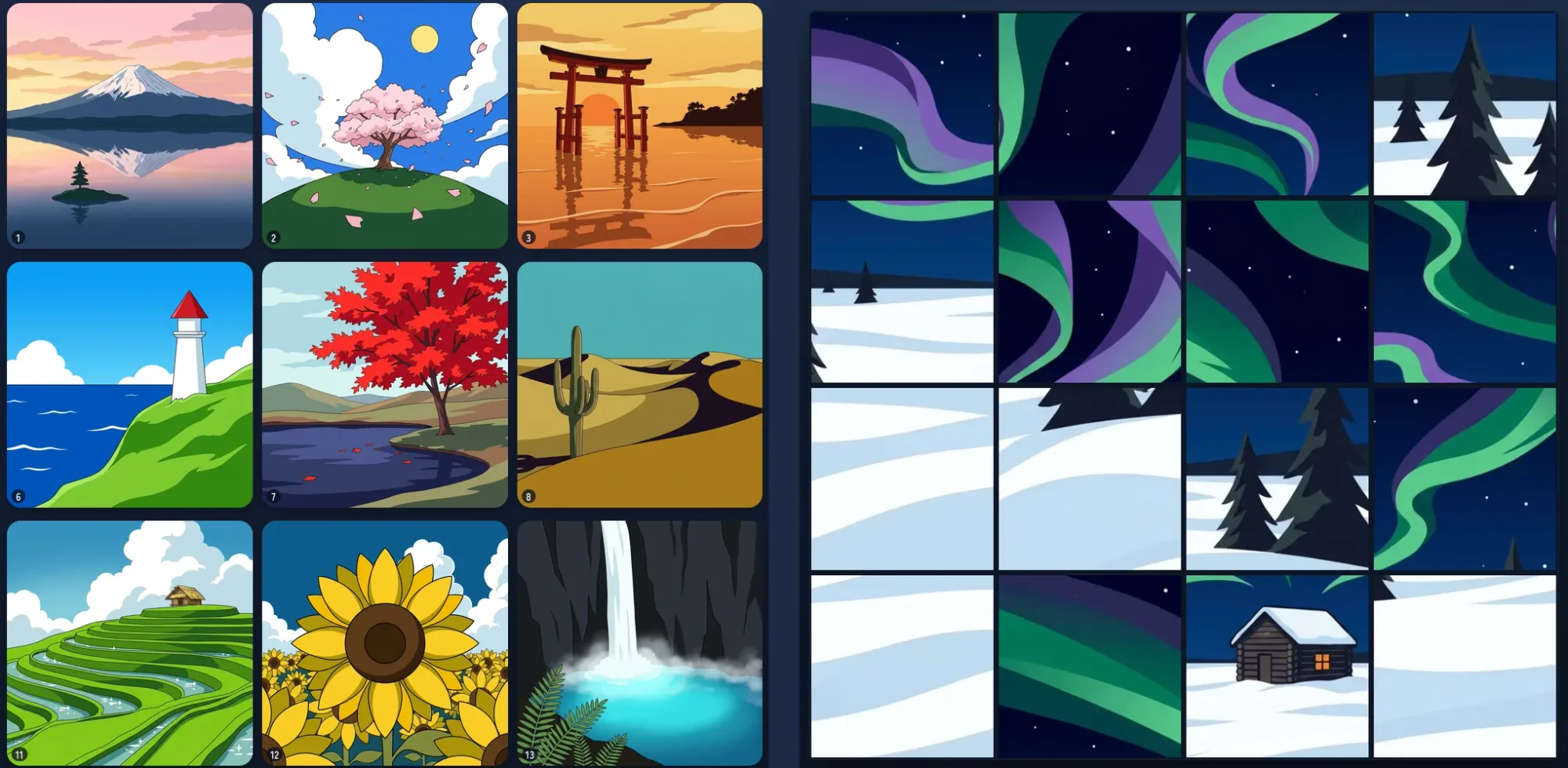
The Ideas Were Hers. The Prompts Were Mine.
The game was her idea, and so were the themes. Quiet nature scenes to start, then a magical boarding school, then animals from around the world. Every 5th level is a Challenge, a taller 6 by 8 grid with a busier painted scene; the other 40 climb from 4 by 4 to 6 by 6. Each scene is a short prompt in a JSON file, rendered by Gemini's image model, cropped to the grid, and committed to the repo. She told me what she wanted. I typed. She told me what was wrong with it. I typed again.
There is plenty of negative press about AI, and some of it is earned. This is one small counterexample. A child had an idea for software, and the distance between that idea and a working app on her tablet closed over a few evenings of prompts. The thing that used to stop a project like this, a parent with the time to hand-write a game engine, is no longer the gate.
A PWA on a Static Host Keeps It Simple, Reachable, and Ad-Free
The game is a progressive web app: React and TypeScript, no server code at all. It deploys to Cloudflare Workers as static assets on a domain I already own, and a service worker precaches every level, art included, the first time a device opens the page. Add it to the home screen and it plays with no network. Flights. Grandparents' houses. Car rides through dead zones. Progress and best times live in local storage on the device. No account, no leaderboard, nothing to buy, and no advertising SDK, because nothing in this stack asked for one. A URL on my own domain has no store, no publisher, and no ad network standing between the game and the tablet. I haven't decided whether to open-source the code. The game itself is open to anyone who wants it, with no ads, no login, and nothing else in the way.
This is the half she never saw: DNS, the certificate, a build that deploys on every push, and cache headers that keep the service worker from going stale. Her design, plus a dad's working knowledge of networking, hosting, and cloud, is what makes the game reachable from any device away from home. 20 years of infrastructure habits aimed at a jigsaw.
It Feels Like GeoCities Again
What I keep noticing is how it feels. My GeoCities page was about military novels, fiction and non-fiction histories alike, posted for no reason beyond wanting to write about what I was reading. In the 90s folks built pages because they wanted something to exist. Nobody was trying to monetize it, at first. The jigsaw has the same shape: made for fun, for a user base of 1, published on the open web because that is the simplest way to get it onto a tablet that leaves the house.
No funnel. No roadmap. 50 levels, 10 of them challenging, and a kid who relaxes, connects a few pieces, and watches the scene come together.
🤖 AIL LEVELS: This content's AI Influence Levels are AIL3 for the writing, and AIL4 for the images. AI Influence Level (AIL) framework