
Reading About It Won't Build It.
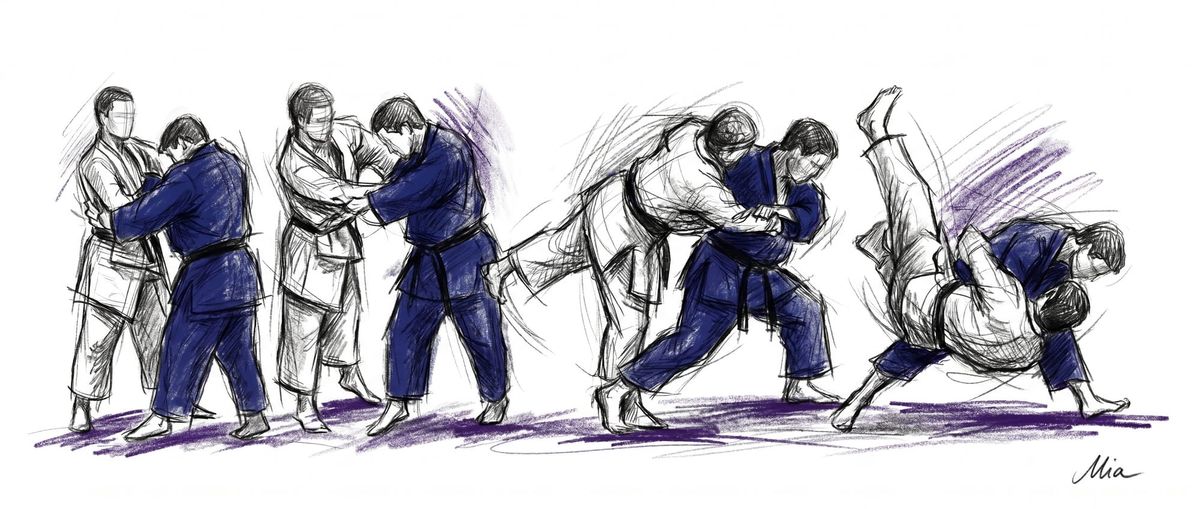
My daughters do martial arts with me. We train in class together; we practice forms at home. You can read every judo textbook ever printed and watch every tutorial on YouTube. The throw will not be there.
The throw develops on the mat: doing it, being thrown, repeating until your body stops thinking about it. The neural pathways form under load. Muscle memory builds under resistance. Instinct comes from repetition, not from reading about repetition.
Doing Is the Learning
Theory describes the skill. Doing builds it. Those are different things, and most of what we call learning is theory.
I can explain the mechanics of a hip throw in accurate detail: entry footwork, grip position, load, rotation, follow-through. Every element, sequenced correctly. It will not help you execute the throw against a resisting partner who doesn't want to be thrown. Your body doesn't have the movement yet. The knowledge is in your head; the skill needs to be in your body, and the only way it gets there is through doing it wrong, doing it less wrong, and doing it right until it's automatic.
This is true for everything.
Near every piece of software I've ever written has been a fail-fast, fail-often experience. That's not a confession; that's the method. The code that doesn't work is not a failure of the process. It is the process. You debug what you built. You can't debug what you only studied.
The tutorial treadmill exists because theory feels like progress. It has the shape of learning: new vocabulary, new frameworks, new understanding. The actual skill stays absent because the actual skill comes from doing, not from understanding doing. At some point you close the tab and write the code, cut the wood, get on the mat. That is when the learning starts.
It Enriches the Rest of Your Life
Nobody mentions this part: learning by doing gives you things that have nothing to do with the skill.
My daughters are in that martial arts class with me. We practice the same forms; we work through the same drills. That bond didn't come from watching martial arts together. It came from doing it together, from shared effort inside the same difficult thing.
The woodworking led to building connections with neighbors. Conversations that started with "what are you building?" turned into discussions about their own projects. I wasn't trying to build friendships through sawdust; I was trying to build furniture. The community was a wonderful side effect of being out there doing it.
Coding my own tools pulled me into online communities I wouldn't have found otherwise, and into coworker conversations that shifted from "how do I do this?" to "we have a version of that problem." Building games meant learning from artists, narrative designers, UI people: skills I didn't have, people I wouldn't have met, domains I never would have entered from the outside.
You discover communities. You build relationships. You make friends. You have more to talk about with more kinds of people. None of this was in the tutorial. It came from doing the work in the world, where the world could respond.
Start Alongside. Learn as You Go. (With One Real Exception.)
Most of what people call "not ready" is "not started."
The exception is genuine: when getting it wrong can hurt you or someone else, the learning comes first. Learn to fly a plane (simulator hours, instructor sign-offs, checklist discipline) before you touch the controls in the air. Learn to use a table saw: where the blade is, what the fence does, the basic rule (cut the wood, not yourself). Real exceptions. Take them seriously.
Everything else? Start now, learn alongside.
And when you finish the stated goal, ask what else it could do. Build the program that does X, then ask if it can do Y. Give the user a choice. Add something the rubric didn't require. That question, not the assignment, is where new neural pathways form. The objective from a lesson is the floor, not the ceiling.
Take the next step. Try the thing. Every black-belt started as a white-belt. Don't fear getting started.