
If I See It, I Think About It
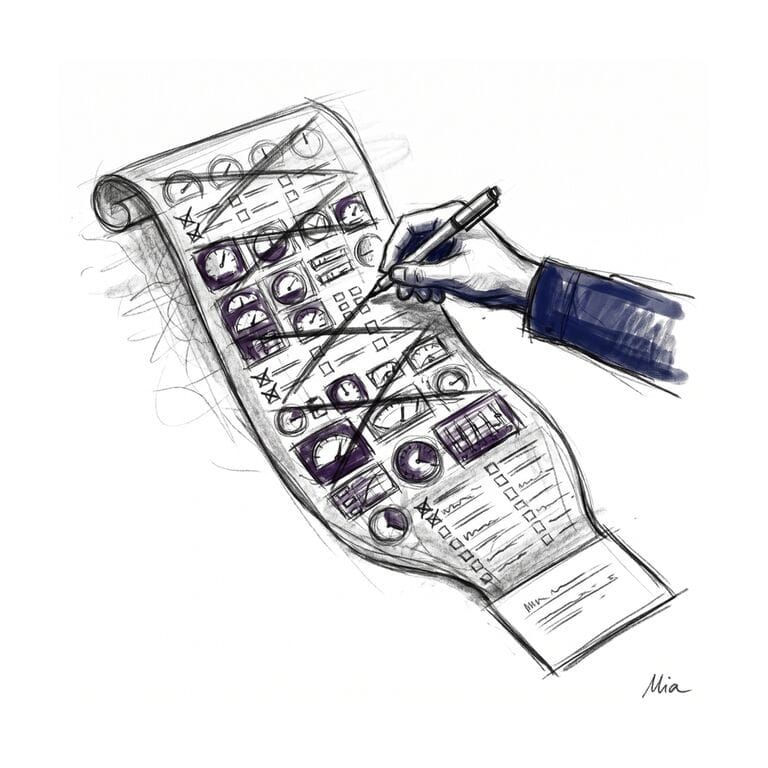
Summer's an odd time for spring cleaning, but that's where I've landed anyway. Newsletter subscriptions I don't open. Sources in my news-feed I skim past more out of guilt than interest. And a Claude Code status line from a project I still adore, sitting in every terminal, that I'd stopped actually reading. If I see it, I read it. If I read it, I think about it. That's wasted energy, spent on information I never needed.
The status line in question was LifeOS's: a state block reading health 60%, creativity 70%, freedom 100%, relationships 90%, finances 90%. A rotating quote at the bottom, currently "The capacity to tolerate uncertainty is a prerequisite for living well" (Irvin Yalom). A context bar broken down file by file, SKILLS at 2.2%, PROJECTS.md at 0.6%, down to PRINCIPAL_TELOS.md at 0.1%. Four separate version numbers tracked at once: harness, model, LifeOS, algorithm. Genuinely useful in getting LifeOS setup. Also exactly the kind of thing I mean by wasted energy when it shows up somewhere I'm not trying to track such minutia, but trying to write code.
What I actually needed, once I sat down and thought about it, was four things. The model I'm on. The folder the session launched from. The weather outside. Because I work from a basement with no windows, the difference between checking a number and stepping out on my next break between meetings is a real decision, not a nice-to-have. And context, plus usage limits, because those two actually touch whether I can keep working in this session or need to switch models. Everything else was a read I'd trained myself to take without ever needing the information in it.
So I handed Claude Code a screenshot of LifeOS's status line as reference, described those four things in a couple of sentences, and told it to ask questions before it wrote anything. The questions did more of the scoping than my description did.
A Reference Is Also an Anchor
Point an AI at a working, idiosyncratic example and ask for something like it, only simpler, and the easy answer is imitation: keep the shape, trim the volume. That's true of most engineers handed the same brief, not just models, because a finished reference is the safest-looking answer in the room. Nothing about LifeOS's status line is wrong for LifeOS. None of it belonged in a status line whose only job was the four things I actually needed. The only way to find that boundary was to ask where it actually sat, feature by feature.
Scoping Is Walking the List and Saying No
That process looked less like generating code and more like scoping a security assessment. You walk it control by control, mark each one in or out, and the assessment costs exactly what you said yes to. Claude Code did the same thing with LifeOS's feature list: health, creativity, and the rest of the state block, out. Per-file context attribution, out (one aggregate percentage was plenty). The quote rotation, out. Weather stayed, but opt-in and configurable, not always rendering. What was left: model, working directory, git branch, a context-usage bar, and the five-hour and weekly rate-limit windows. Every no was scope removed, not scope deferred.
What's Left After You Say No Enough Times
clean.status is 201 lines of bash, four dependencies you probably already have (bash, jq, curl, git), and two lines of terminal output: model and folder on the first line, weather when it's configured, context usage and rate limits on the second. Every line in it survived someone asking whether it was needed, against a working reference that had plenty it didn't need to include. Good architecture is boring for that reason: it's been through the same audit.
The test I was actually running wasn't whether Claude Code could write a status line. It was whether it would build the one I needed instead of the one already sitting in front of it. The only variable was whether I made it ask first. Four things cross my terminal now. Everything else stopped costing me a read. This is the new power I'm seeing with AI, customization of experiences that help me focus on what matters without writing a line of code or touching a configuration file. I describe what I'd like, I answered a few questions, and the result appeared. AI is looking less like "slop" and more "helpful" with each lesson learned and each model or harness improvement.
🤖 AIL LEVELS: This content's AI Influence Levels are AIL2 for the writing, and AIL4 for the images. [AI Influence Level (AIL) framework](https://danielmiessler.com/blog/ai-influence-level-ail)