
From Intern to Department Head
By Randy Armknecht
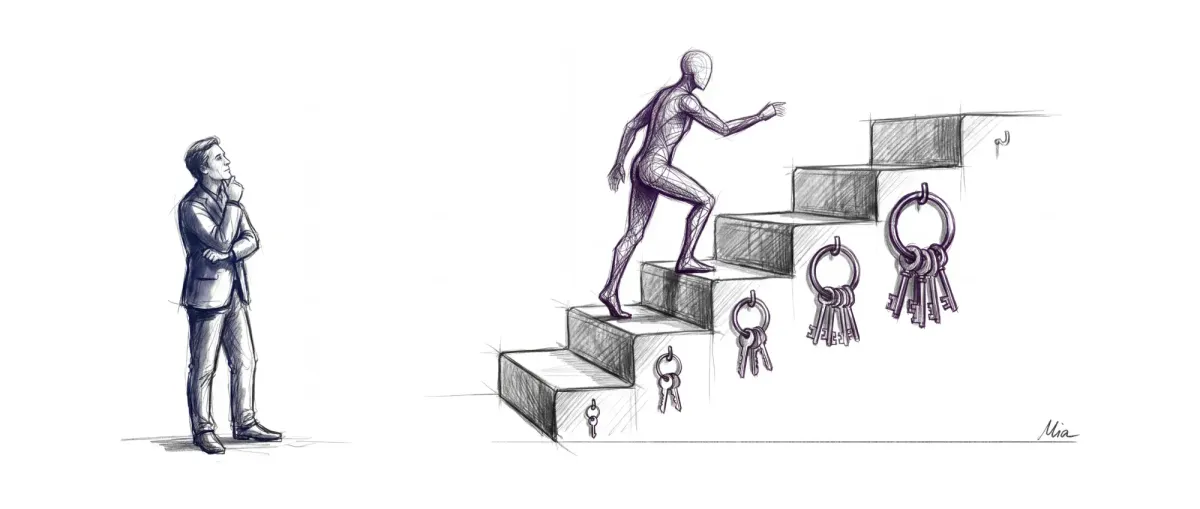
When coworkers ask how I use AI, I describe it like staff. For a while it was "my intern." Then it became "a new consultant." A few weeks ago I heard myself call it "a senior." I never planned the promotions. Looking back, each one tracked a change in what I was willing to hand over and how much of the work I still had to check. The levels of AI usage form a career ladder, and the thing that moves anyone up a ladder is trust, earned over time and backed by controls.
| Level | What changes |
|---|---|
| AskIntern | Delegate a single answer or artifact, in text or images. |
| InformNew consultant | Delegate with personal context: files, projects, memory, connected data. |
| BuildSenior | Delegate the creation of tools through an agentic harness. |
| ExtendManager | Give the AI new capabilities through MCP, skills, and integrations like Blender. |
| OperatePrincipal | The AI acts on real systems, such as remote deployments and messages across machines. Humans drive. |
| OrchestrateDepartment head | Multi-step workflows run with handoffs, tests, and validation gates. Humans supervise rather than drive. |
Every Promotion Is a Bigger Delegation
The intern answers questions. A prompt goes in, a draft comes out, and I check every line. Image generation lives here too. Asking for a picture of a data center takes the same skill and the same trust as asking for a paragraph about one.
The new consultant gets onboarded. I hand over the binder: files, screenshots, project instructions, and the context of prior conversations. Answers stop being generic and start reflecting my world. Plenty of folks plateau here, and it's a productive place to plateau.
The senior gets an objective instead of instructions. I point at the wall and expect it to find its own way to the top. Claude Code, Codex, and similar harnesses live here; I define the outcome, and the harness reads, writes, runs, and fixes until a working tool exists. I've used Claude Code since its first release, and it's still my harness of choice.
The ladder never asks for code. A non-technical executive can skip the harness entirely and reach the upper levels through tools that act inside the apps they already use. The ladder measures delegation, and coding is one path up it.
The Top Three Rungs Hand Over the Keys
The next 3 promotions hand over something heavier than tasks.
The manager gets the firm's methodology and access to its tools. In AI terms that's MCP servers, custom skills, and integrations with software like Blender. The AI stops working from what it knows and starts working inside the systems I use. I reached this level when I started building custom skills and applying them to my own problems: how I write, which Hacker News content I care about, and summarizing YouTube videos so I only watch the ones with something new.
The principal runs operations. The AI acts across multiple machines, sends instructions to remote deployments, and manages them with real credentials. I'm still in the loop, approving changes the way a change advisory board would. This is where I am today. Claude built Threadmark, my MCP server that acts as a centralized memory and task tracker per project across models and harnesses. It built the application to my specifications, deployed it to Cloudflare, and configured the CI/CD pipeline so each merge to main results in a fresh production instance. My command center, also on Cloudflare, is where the approving happens. Every agent and service I run reports into it. When Warden, my security scanner, finds a new vulnerability, Mia, my resident assistant, proposes a remediation, and I give Mia the green light, send feedback, or put it on hold.
The department head runs a team. Multi-step workflows hand work from one agent to the next, with testing and validation gates between tasks. My role moves from approving each step to reviewing outcomes and exceptions. That shift, from human in the loop to human on the loop, is the largest jump on the ladder. I'm not there yet. The command center is built for it, but today every remediation still waits on my approval.
Promotion Controls Already Exist
A well-run organization doesn't give any new hire (let alone an "intern") domain admin on day one. A new hire gets a background check, least-privilege access, a probation period, and a manager who reviews the work. As they prove reliable, access expands, and periodic access reviews confirm they still need it. Senior roles carry separation of duties so one person can't both make a change and approve it.
Each AI promotion widens the blast radius the same way. A bad intern output is a bad paragraph. A bad principal action is a misconfigured production deployment, executed with valid credentials. The controls have to scale with the level: scoped identities for agents, audit trails for every tool call, approval gates before production changes, and test harnesses that validate one agent's work before the next agent picks it up.
The command center enforces those controls rather than trusting good behavior. Each agent signs what it posts with its own Ed25519 key, so a message from Warden provably came from Warden. My decisions are signed with a passkey, so no agent can approve its own work. Warden is read-only; it can find a flaw and hand the fix to Mia, but it can't change the code it scanned. One finds, one fixes, one approves.
None of that is new. Identity, logging, change management, and quality assurance are the same controls security programs have run for decades. What changed is the employee, and how quickly it can be promoted. The temptation is to skip straight to department head and leave the onboarding for later.
My AI today is a principal on probation. Before it made principal on anything I care about, it got what anyone on my team gets: scoped access, a record of everything it touched, and a reviewer who reads the results.
🤖 AIL LEVELS: This content's AI Influence Levels are AIL2 for the writing, and AIL4 for the images. AI Influence Level (AIL) framework