The Most Undervalued Skill in Your Professional Toolkit: Clear Thinking
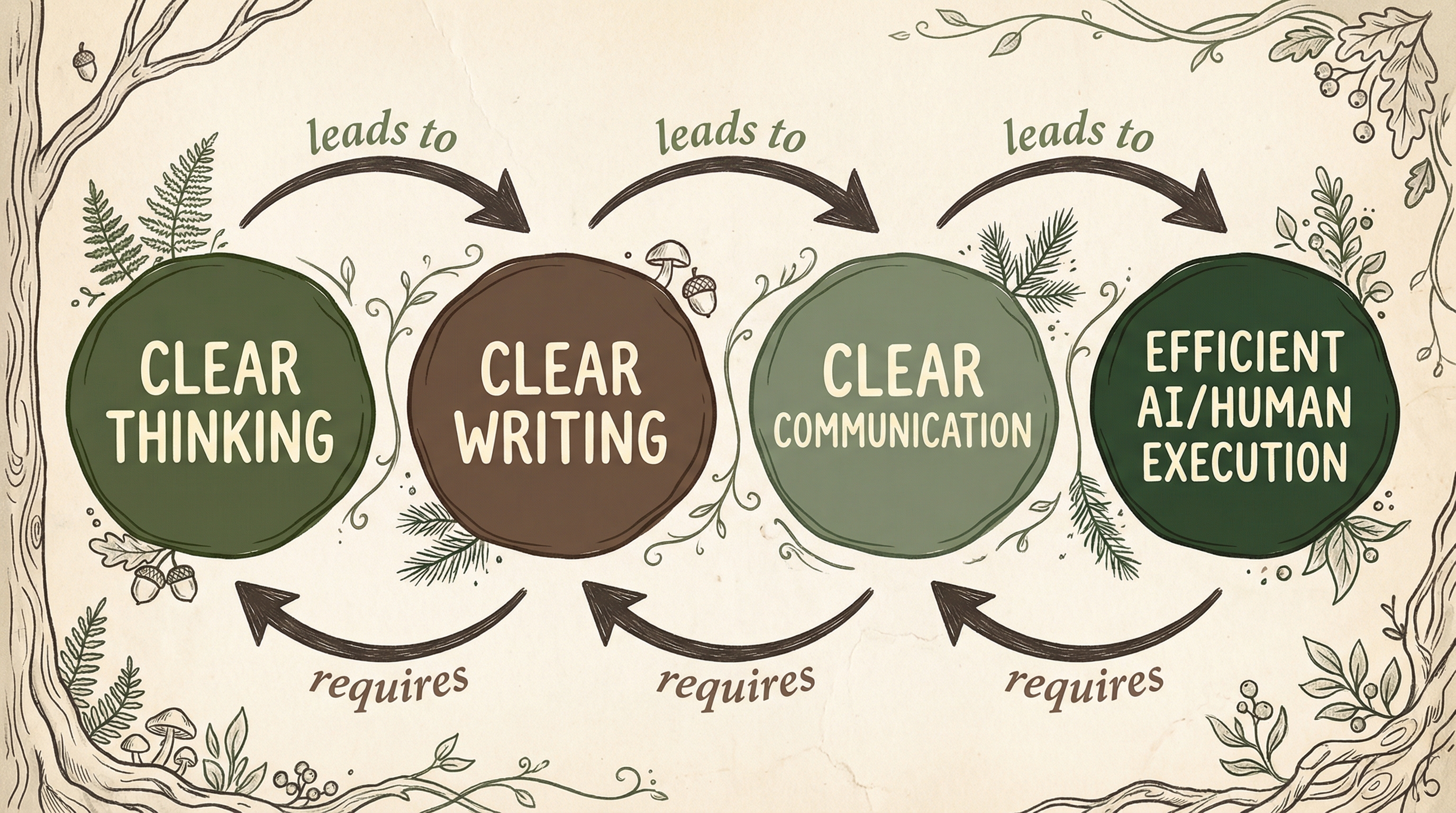
This week, I’ve been struck by how often the concept of “clear thinking” has surfaced in my world. It’s a wonderful example of synchronicity.
When Everything Connects
It started with a coworker asking why I’d suddenly begun writing more this year. I explained writing forces me to clarify my thoughts in ways that mental notes never could. Then came a client discussion about regulatory impacts on their operations and how clear messaging to team was essential for smooth adaptation.
Later, during a Tech Advisory Board meeting for City Colleges of Chicago, the same theme emerged. The most valuable skills employers seek from apprentices aren’t the technical skills, it’s the professional competencies, the soft skills. And in my reading this year, from the Japanese art of Ichigo Ichie to Pico Iyer’s take on the Art of Stillness, authors keep circling back to this fundamental skill.
The final nudge came from watching Daniel Meissler’s work on his open-source Personal AI Infrastructure project. His diagram perfectly captured what I think of as “half the equation”, how each step in the chain improves context of the next. But I realized the other half is equally critical: how each step of the chain requires the previous.
Why Clear Thinking Matters More Than Ever
Here’s what I believe: clear thinking and the ability to communicate those thoughts (whether to people or AI systems) is easily the most valuable skill a professional can have.
Think about it. We’re drowning in information, tools, and options. The differentiator isn’t access to data or even technical skills (though those matter). It’s the ability to cut through noise, see what actually matters, and articulate it in ways others can understand and act upon.
In my conversations this week, the breakthroughs didn’t come from having better tools or more expertise. They came from pausing, thinking clearly about the real problem, and then expressing that clarity to others.
The Practice of Purposeful Thought
Clear thinking needn’t be limited to big decisions, it can be a daily practice. When we get caught up in the flow of endless meetings, emails, and reactive tasks, we stop thinking deliberately. We start operating on autopilot.
But what if we didn’t?
Here’s my challenge to myself and anyone reading this: embrace purposeful thought this month.
-
Find moments of silence and actually think. Not about your to-do list, but about the problems you’re trying to solve.
-
Before important decisions, pause for clarity. Ask yourself: What am I really trying to achieve? What are my options? What do I actually know versus what am I assuming?
-
Test your thinking by writing or explaining it out loud. If you can’t express it clearly, you probably don’t understand it clearly.
Your Month-Long Experiment
Don’t let yourself be lost in the flow of life. Before your next meeting, strategic decision, or discussion, take five minutes of purposeful thought. Get clear on what you’re trying to accomplish and why it matters.
I’m betting you’ll notice a difference: in your decision quality, your communication, and maybe even in the opportunities that start presenting themselves.
After all, in a world full of noise, clarity isn’t just valuable, it’s magnetic.
🤖 AIL LEVELS: This content’s AI Influence Levels are AIL3 for the writing, and AIL4 for the images. AI Influence Level (AIL) framework